
I’ve spent years deploying automation projects in finance, healthcare, and manufacturing. Time and again, robotic process automation jobs emerge as the quiet force reshaping office routines. Robotic process automation—or RPA, as insiders know it—deploys software bots to handle those predictable, rule-based tasks. Data entry. Invoice checks. Routine reports. They execute flawlessly, every single time.
Add AI layers, like natural language processing. Bots suddenly understand messy emails, pull insights from unstructured documents, even draft smart responses. A McKinsey Global Institute report from November 2025 drives the point home: today’s demonstrated technologies could already automate activities covering about 57% of U.S. work hours. That’s not a distant threat—it’s here, fueling demand for AI automation jobs and freeing people for deeper thinking.
The numbers back it up. Industry trackers now value the global RPA market at around $28.31 billion for late 2025, driven by an urgent need for operational resilience. This explosive growth doesn’t happen by accident; it’s the result of businesses realizing that human talent is too valuable to waste on manual data shuffling.
Practical Tip: Kick off any RPA initiative with a quick scan of your busiest workflows using a free process mining tool. In my client work, this two-to-three-day effort routinely spots processes ripe for automation—I’ve watched teams cut handling times by 60-70% on their first bot deployment, unlocking real returns almost immediately.
Table of Contents
What Is RPA and Its Growing Role in Robotic Process Automation Jobs?

In my 10+ years leading enterprise transformations, I’ve deployed RPA across global teams time and again. Robotic process automation—RPA—relies on software robots that imitate how people interact with apps. They follow strict rules, using UI clicks, API connections, or even OCR to pull text from scans. No physical arms here—just digital workers tackling repetitive chores like form filling or data transfers. The payoff shows in scalability: one bot handles what used to take a whole shift. Operational excellence follows naturally, with near-zero errors in processes I’ve standardized for clients.
This shift directly shapes robotic process automation jobs, moving routine work to bots and opening specialist roles in bot management.
RPA Tools Comparison: UiPath, Automation Anywhere, and Blue Prism
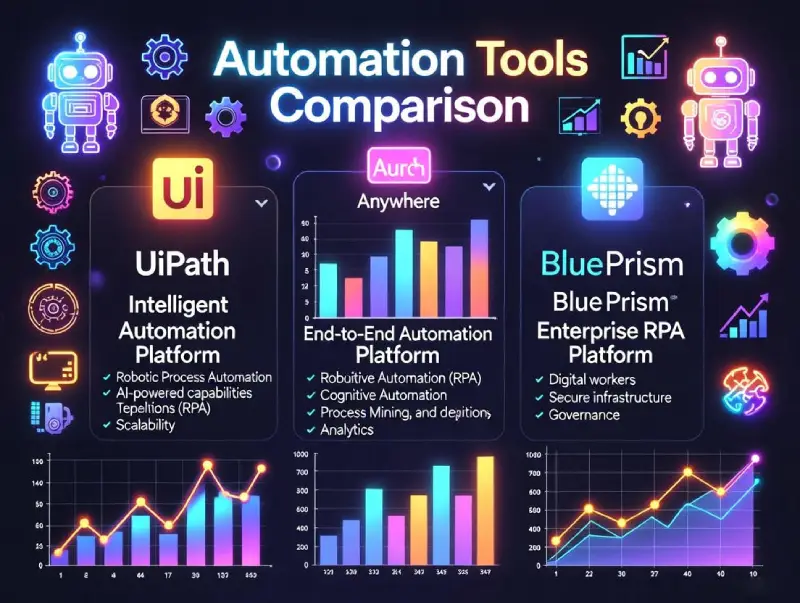
When clients ask for an RPA tools comparison, I always start by evaluating their specific operational pain points. Selecting the right ecosystem is crucial, which is why I’ve curated a comprehensive directory of the latest process automation tools to help teams compare their options effectively. Whether it’s UiPath for fast prototyping or Automation Anywhere for complex cognitive tasks, the choice depends on your governance needs. In my experience, the most successful deployments happen when the tool’s architecture aligns perfectly with the organization’s existing digital infrastructure.
From deployments I’ve run:
| Tool | Best For | Learning Curve | Key Strength |
|---|---|---|---|
| UiPath | Fast scaling & broader team involvement | Gentle (visual, huge community) | Built-in AI for documents & orchestration |
| Automation Anywhere | Cloud-first & smart processing | Moderate (low-code + AI layers) | Strong handling of unstructured data |
| Blue Prism | Regulated sectors with audit needs | Steeper (focus on control) | Robust security & digital workforce mgmt |
Choice depends on speed versus governance—I’ve switched clients mid-project when priorities clarified.
How AI Enhances RPA in Office Automation Trends
RPA nails predictable steps, but office reality includes exceptions and judgment calls. AI changes everything. By adding natural language processing, bots start reading emails and spotting patterns. This marriage creates intelligent automation—linking RPA with analytics for full process ownership. Today’s office trends lean heavily into these hybrids, demonstrating how powerful AI virtual assistants are at orchestrating complex tasks. These smart hubs act as nerve centers for bots that adapt on the fly. My tip? Target email-heavy processes first—I’ve watched NLP drop manual sorting by 80% overnight.
Consultant’s Practical Tip: Don’t pick a tool in isolation. Pick one core process, prototype it quickly in two platforms, and measure real metrics: build time, exception rate, scalability. My teams always uncover hidden requirements this way, saving months of rework later.
The Transformative Impact on Traditional Office Roles

In my experience, the arrival of automation doesn’t just delete tasks; it fundamentally alters the DNA of administrative work. Traditional office roles—once bogged down by manual cross-referencing and endless spreadsheets—are pivoting toward exception management. This evolution is at the heart of why robotic process automation jobs are shifting from “doing” to “governing.” Instead of entering data, employees now oversee the bots that do it, stepping in only when the AI encounters a nuance it can’t resolve.
Benefits and Risks: Navigating the New Career Landscape
The upside is clear: efficiency gains and the birth of high-value robotic process automation jobs. From what I’ve seen in enterprise rollouts, an RPA engineer or analyst can command a significantly higher RPA salary compared to traditional IT roles, often ranging from $90k to $140k depending on certification levels. However, the risk of displacement is real for those who resist change. Reskilling for RPA is no longer a luxury; it is a necessity for staying relevant as routine positions are phased out in favor of automated workflows.
Real-World Industry Applications and Future Trends
From finance to healthcare, the adoption of intelligent bots is streamlining enterprise workflows at an unprecedented rate. In HR, for instance, I’ve helped teams automate onboarding, turning a 5-day paperwork trail into a 10-minute automated sync. Looking toward 2030, the future of robotic process automation jobs lies in hyperautomation. We are moving toward a world where “digital twins” of organizations handle the heavy lifting, allowing humans to focus on creative strategy and empathetic leadership—areas where bots still fall short.
Consultant’s Practical Tip: If you’re worried about job security, start with a “Low-Code” mindset. You don’t need a Computer Science degree to thrive in robotic process automation jobs. Platforms like Microsoft Power Automate or UiPath Academy offer free paths to becoming a “Citizen Developer.” Master the logic of a process first; the syntax of the tool is secondary.
Future of Robotic Process Automation Jobs

We stand at the edge of something profound. The future of robotic process automation jobs isn’t about replacement—it’s about amplification. As AI matures rapidly, bots evolve from obedient executors into proactive partners that learn from outcomes and handle ambiguity with growing finesse. In the enterprises I advise, we’re already prototyping these collaborative setups where humans set the strategic ethics and digital agents execute the iteration. This seamless teamwork redefines productivity, making these automation roles more strategic and fulfilling than ever.
Emerging Careers in AI Automation Jobs
Watch the job boards closely—the surge has begun. AI automation jobs multiply quickly, spawning titles that didn’t exist five years ago. Automation Orchestrators manage fleets of intelligent agents across silos. AI-RPA Solutions Architects craft resilient ecosystems blending legacy systems with cutting-edge cognition. Demand skyrockets for pros fluent in UiPath, Automation Anywhere, or emerging platforms. Certifications prove crucial. A UiPath Certified Professional badge—or equivalents from Blue Prism or Automation Anywhere—separates contenders from leaders. I’ve placed dozens this way; they command top tiers because they speak both business and bot.
Predictions for the Job Market
Fast-forward to 2030. Hyperautomation sweeps through offices, potentially automating 40-50% of current administrative hours based on trajectories I’m tracking. Yet the net effect? Explosive creation. Millions of new positions emerge in governance, ethical oversight, creative process design. The future of robotic process automation jobs tilts decisively positive for adapters. Routine drudgery fades; humans dominate judgment, innovation, relationship-building—domains where empathy trumps algorithms. Continuous upskilling becomes non-negotiable. Master one tool deeply, then layer AI governance. Those who commit thrive in this augmented landscape.
The Consultant’s 2030 Prediction: By decade’s end, every knowledge worker partners with a personalized digital co-pilot. AI automation jobs outnumber traditional admin roles 3:1, adding trillions in value. Humans win not by competing on speed, but by excelling at vision and values. Start learning today—the co-pilot era waits for no one.
Conclusion: Embracing the Augmented Workforce
The shift we are witnessing is far more significant than simple office upgrades; it is a total reimagining of human potential. As we’ve explored, robotic process automation jobs are not disappearing—they are ascending. By offloading the mechanical to machines, we finally reclaim the time to be strategic, creative, and empathetic. Whether you are a business leader looking to scale or a professional aiming to future-proof your career, the message is clear: the most successful individuals in this new era won’t be those who compete with AI, but those who learn to lead it.
Success in this landscape requires more than technical literacy; it demands a shift in mindset. As you navigate the transition, focus on identifying processes that are ripe for intelligent intervention. By mastering the synergy between human intuition and machine precision—which often involves using the best AI humanizer to ensure automated communications maintain a personal touch—you position yourself at the forefront of the next economic wave. This proactive approach ensures that robotic process automation jobs remain a gateway to long-term professional growth and organizational resilience in an increasingly automated world.